2026 Nobel Prize in Medicine: How Light-Controlled Neurons Are Transforming Neuroscience
2026-10-07

2026-10-07
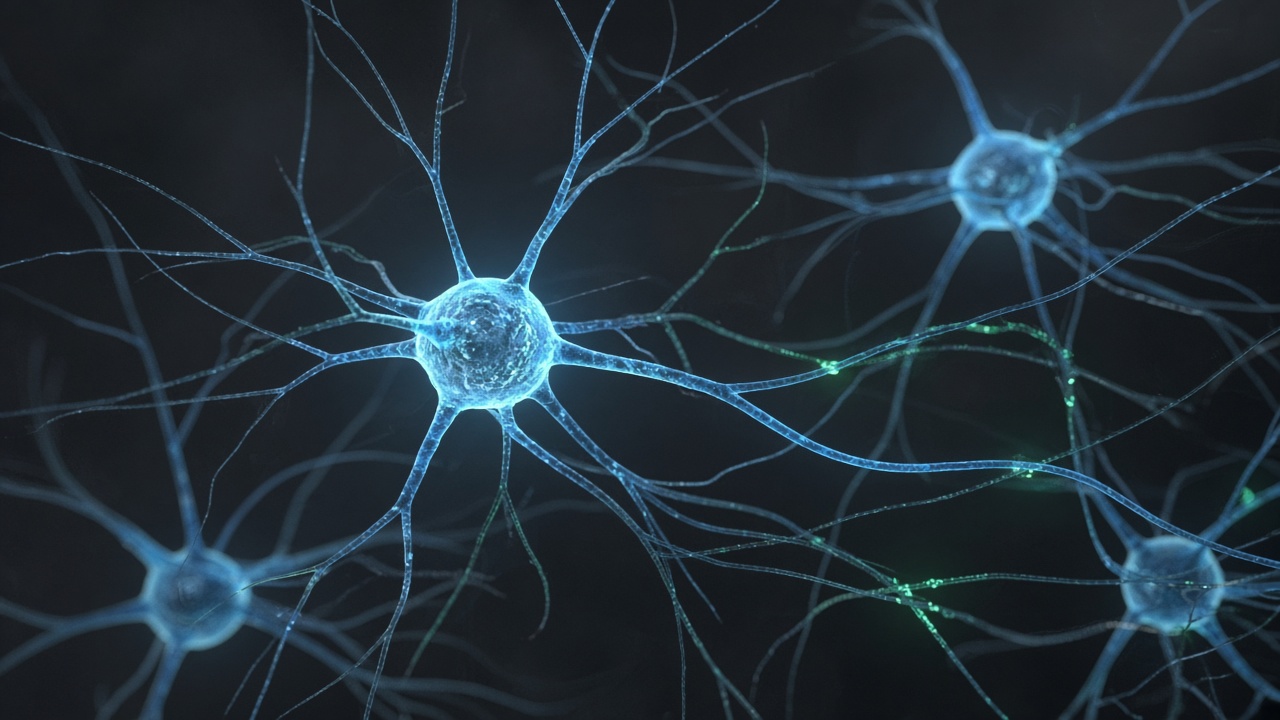
Conceptual illustration of neurons and blue light, made for this site. Not a photograph of an experiment and not a figure from a paper.
Promising Level C · preliminary human evidence
On 5 October 2026 the Nobel Assembly at Karolinska Institutet announced the Nobel Prize in Physiology or Medicine. It is shared by Karl Deisseroth, Peter Hegemann and Georg Nagel for their discoveries concerning light-gated ion channels and optogenetics. Deisseroth is at the Howard Hughes Medical Institute and Stanford University. Hegemann is at Humboldt University of Berlin. Nagel is at the University of Würzburg. The prize is 12 million Swedish kronor, shared equally. This note follows the official press release and the official popular explanation. It is not a clinical trial, and it does not present optogenetics as a way to lengthen life.
Twentieth-century work could link brain regions to functions. That map could not prove that one kind of nerve cell caused a memory, a feeling or a behaviour. Nerve signals are very fast. Francis Crick, already a Nobel laureate in 1962 for DNA, pictured light as a way to activate single cells in a living brain. The official note recalls that idea as a wish, not as the experiment. The experiment arrived by another route: a single-celled alga.
Chlamydomonas swims toward light. It uses an eyespot, a point that contains retinal, a light-capturing molecule. In the early 1990s Hegemann, then at the Max Planck Institute for Biochemistry in Martinsried, measured the current from that eyespot. The popular note says an electrical impulse appeared about half a millisecond after the light. In a human eye, the chain from light to an ion channel takes at least about 10 milliseconds. Hegemann proposed a simpler account: one protein would both capture light and be the channel. No ion channel was known then that responded to light on its own. The idea met scepticism.
The protein was hard to study once it left the alga. Around the turn of the millennium, a genetic map of Chlamydomonas, made by Japanese researchers and described that way in the Nobel note, showed genes similar to known light-capturing proteins. Hegemann worked with Georg Nagel at the Max Planck Institute for Biophysics in Frankfurt. Nagel put those genes into frog egg cells. The cells made the proteins and placed them in the membrane. Light opened the channel and ions flowed. That is how channelrhodopsin-1 and channelrhodopsin-2 were described. The official note points to two papers from that stretch: Nagel and colleagues, Science, 2002, and Nagel and colleagues, PNAS, 2003.
Channelrhodopsin-2 responded to a pulse of light in about 0.2 milliseconds in that characterisation. Positively charged ions entered and an electrical signal appeared. Hegemann and Nagel also put the gene into human embryonic kidney cells and into hamster kidney cells. Those cells, which are not neurons, became sensitive to light. In 2003 they proposed the protein as a tool for making impulses with light. Up to that point the finding is cellular: an alga, frog eggs and kidney cells. It is not a treatment.
Deisseroth came from a psychiatric clinic and a PhD in neuroscience. The official note says he wanted to study nerve cells in a living brain, not only in a tissue slice. When he learned of channelrhodopsin-2, he asked Nagel for the DNA. His group put it into cultured rat neurons. The cells made the protein. Blue light produced a nerve signal that could pass to other neurons. That work was published in 2005. The Nobel note identifies it as Boyden, Zhang, Bamberg, Nagel and Deisseroth, Nature Neuroscience, 2005. It is still a cell experiment, not a human one.
In 2006 the method was named optogenetics. In 2007 Deisseroth's group made it work in living mice. They put the gene into a type of neuron in the motor cortex and illuminated the cells with an optical fibre. The note says they could move the mouse's whiskers. It cites that step as Aravanis and colleagues, Journal of Neural Engineering, 2007. The same year, another experiment in that line woke mice by illuminating neurons linked to wakefulness. In 2012, with Susumu Tonegawa, a set of neurons tied to a fearful experience was reactivated in mice. The animals showed signs of fear while they were not in danger at that moment. The note presents this as a mouse experiment about one memory. It is not a human result, and it does not say a person's memory can be erased or written.
The official explanation describes a use that spread through laboratories: switching circuits on or off and watching behaviour. It mentions, as examples of that map, circuits linked to pain, social behaviour, thirst, eating, reward, attention, circadian rhythm, and fever when the immune system is activated. It also says that separate parts of a behaviour, such as how mice care for their young, can depend on separate circuits. Don't Die Now has not reviewed each of those papers. They are cited here as the committee's summary, not as a list of therapies.
The same note says optogenetics has been used outside the brain, and that work by Deisseroth linked a heart driven at a higher rate with stronger feelings of anxiety. That is a research finding about the body and emotion. It is not a direction to treat anxiety with light, and it is not a longevity result.
The popular note says ongoing clinical trials are attempting to restore vision in people with retinitis pigmentosa, a disease that damages rods and cones. It describes a step in which a channelrhodopsin-like protein was introduced into the retina of a blind person and, with glasses that emit light, that person could discern and grasp objects on a table. This page reads that as what the Nobel text says: a clinical attempt in a retinal disease, in one person, not an approved treatment and not evidence that the method generally gives sight back.
This site already has a separate note on a phase 1 photoswitch trial in advanced retinitis pigmentosa. That note remains a disease study, not a longevity trial, and it is not the Nobel announcement. The two should not be folded together.
On cochlear implants, the note speaks of a hope: stimulating the auditory nerve with light, more precisely than with electricity. That is a possibility described by the committee, not a clinical result this site can treat as settled.
The same source says the method has helped researchers study features of depression, anxiety, schizophrenia, Alzheimer's disease and Parkinson's disease. Helping a study is not the same as treating a person. These official pages do not describe an approved optogenetic treatment for those diseases, and Don't Die Now does not invent one.
Most of the awarded path happened in an alga, in frog eggs, in kidney cells, in rat neurons and in mice. The human step the note highlights is an attempt in an eye disease, not everyday use in neurology. Optogenetics requires introducing a gene and, in an animal brain, delivering light to those cells. This page does not recommend that procedure, and it does not publish a protocol.
A circuit found in a mouse is not, by itself, a closed explanation of a human disease. A model can be precise and still not be a therapy.
The brain takes part in memory, sleep, movement and autonomy. Understanding circuits can matter for healthspan: the years in which a person can still do what they value. The prize does not measure years of life. It does not say that optogenetics slows aging, lengthens human life, or is a product. A tool for reading the nervous system is not an anti-aging intervention.
The fair link is this one. Neuroscience gains a switch for questions that could not be asked cell by cell. Medicine, in vision, has clinical attempts that should be read as disease trials. Longevity, in this note, does not gain a treatment.